Building Safety

Pete Thomas
News
8 min read

For years, 11 metres has been the line that decided whether a building's cladding was the government's problem or the owner's problem. Tall enough, and there was a route to funding. Just under it, and you were largely on your own, even with the same combustible materials on the wall.
That changes on 17 August 2026, when Homes England opens a new fund specifically for cladding remediation on residential buildings under 11 metres. For most blocks this will not apply. The government has been clear that the great majority of under-11m stock needs no cladding work.[1] But for the ones that do, the scheme is only running for eight weeks, closing on 9 October 2026.[2] After that, the window closes. There's no provision for late applications.
Nobody's counted these buildings
MHCLG sampled over 5,000 buildings from Ordnance Survey to estimate how many residential buildings sit between 11 and 18 metres: somewhere between 39,000 and 59,000.[3] But for multi-occupied blocks under 11 metres, this work has never been done. Broader building data exists, but nobody's filtered and cross-referenced it to build a definitive register. Asked directly under Freedom of Information how many blocks of flats exist in an area, the Office for National Statistics said they don't hold a figure.[4]
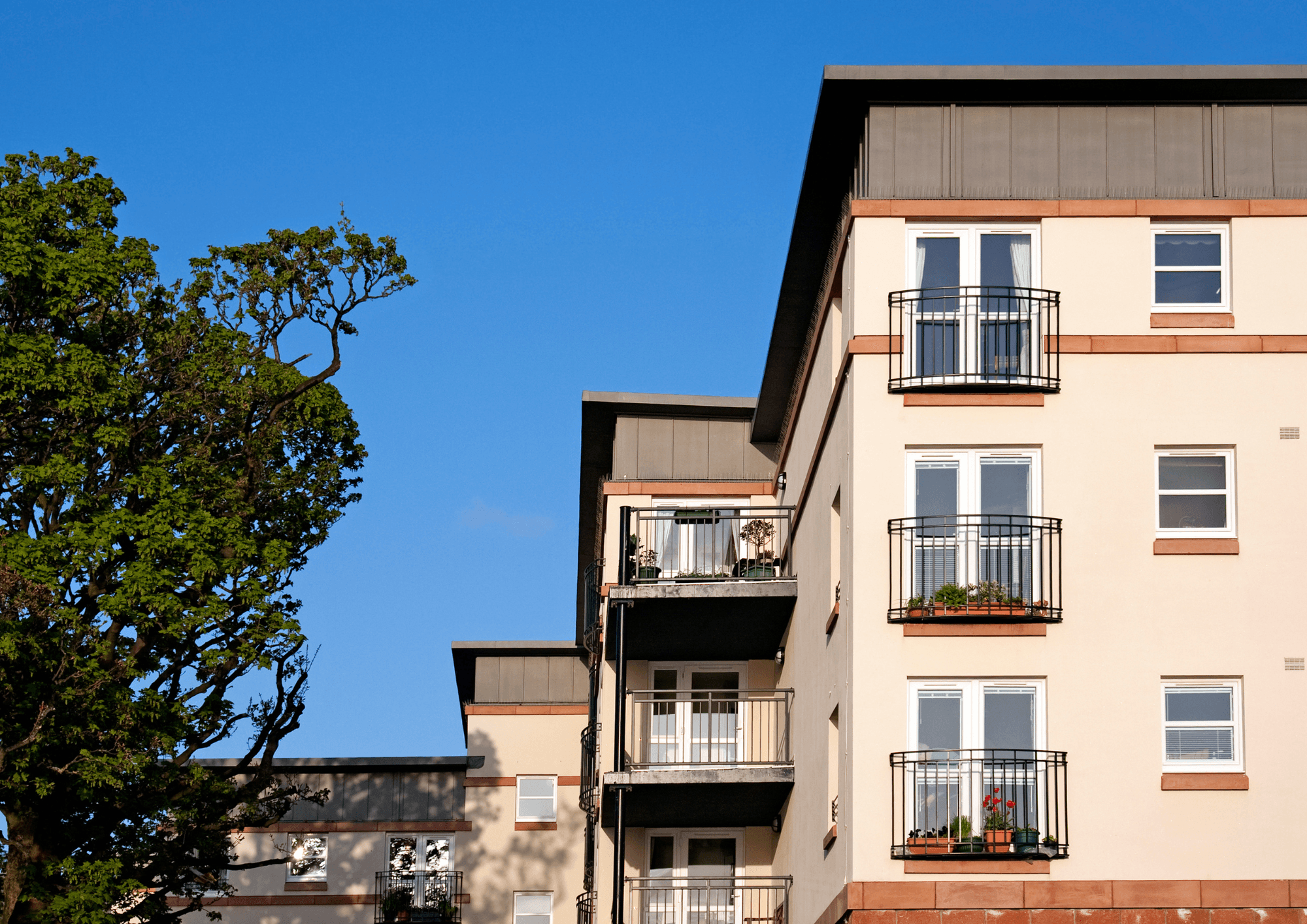
No one is going to tell you which of your blocks might qualify. There is no list to be on. Working it out falls to you, and the window is short.
You might have an EWS1. You probably don't have a FRAEW.
Since May 2022 the Fire Safety Order has covered the external walls of every building containing two or more flats, whatever its height. So your fire risk assessment has to consider them. That is not the same as having a FRAEW.[5]
A Fire Risk Appraisal of External Walls, carried out to PAS 9980:2022, is the step up from there: the specialist appraisal you commission when the fire risk assessment can't settle the external wall risk on its own. For most low-rise blocks that step never came, so there's nothing on file.
This fund runs on the FRAEW. Without one, you cannot apply.[2][6]
So what do I do now?
If a block does have a genuine cladding problem, there's now, for the first time, a real route to public funding to fix it, though funding is prioritised against risk criteria rather than guaranteed to every eligible block.[2] Where a compliant FRAEW already exists, that's one less thing to do. Where it doesn't, it has to be commissioned, completed and come back with a finding of intolerable risk with enough of the eight weeks left to actually submit the application. These assessments take time to arrange and carry out properly, and there are only so many qualified assessors capable of producing a PAS 9980 FRAEW in the first place. Securing one inside an eight-week window, when every landlord with a large estate is trying to book the same limited pool at the same time, is not something to leave to the final fortnight.
If you hold a few thousand blocks, or even a few hundred, which of them justify a FRAEW, and how do you identify them in the first week rather than the sixth? Going through paper files and old assessments one block at a time is not realistic in the time you have.
How the funding is prioritised
Funding is not a single first come, first served queue. High-risk buildings are considered first, as a tier. Any funding left may then go to other buildings, with no commitment to fund all of them.[1][2] Within the high-risk tier, applications are time-stamped and processed in the order received, so a strong case filed in week six sits behind an equal one filed in week one.[2] Homes England audits every FRAEW before confirming funding, and meeting the published criteria does not guarantee an award.[2]
No overall budget or per-building cap has been published, and both are still open questions for Homes England. Filing after the eight-week window closes means an application isn't accepted at all, regardless of risk. Filing within the window is necessary but not sufficient: a block that isn't high-risk, or a high-risk block that files late in the window rather than early, may still miss out even though the application itself was valid, simply because the funding may run out before it's reached. There is no certainty about a next round.
The real risk isn't "does our block qualify." It's "do we find out quickly enough to file early." Someone else's block, filed a week before yours, can take the funding your equally strong case would otherwise have had.
What a complete application needs
A valid application is more than a risk rating on a spreadsheet. It needs:[2]
A PAS 9980:2022-compliant FRAEW, with a finding that the cladding risk is not tolerable without remediation.
A Fire Risk Assessment alongside it, where one exists.
Clear evidence of who the Responsible Entity is: the freeholder, head leaseholder, registered provider, management company or RTM company legally on the hook for external repairs. This is the fund's own defined term, and it isn't the same thing as a Principal Accountable Person under the Building Safety Act, which applies specifically to higher-risk buildings and won't apply to most sub-11m blocks.
Evidence that other routes have already been explored and ruled out: insurance claims, developer contributions, warranty schemes.
Confirmation the building qualifies on the basics: multi-occupied, two or more dwellings, and no remediation work already started before 9 July 2026, which disqualifies a building outright.
You may already have what you need
The good news is much of what you need to make a first decision already exists. It is in the fire risk assessments, the fire strategies, and, if you work with RiskBase, the building records you have built up over the years. The information is rarely missing. It is just spread across hundreds or thousands of records, in different formats and different years, with no single view of it.
If your blocks were assessed piecemeal over the years, by different consultants against different standards, you may not yet know which of them qualify. Older assessments, especially anything carried out before PAS 9980:2022 existed, were often done against less rigorous guidance, and engineers' understanding of what actually constitutes intolerable cladding risk has moved on considerably since. A rating that looked fine in 2019 isn't a reliable answer today, and a rating that looked concerning under the old guidance may not meet this fund's specific threshold either. Treat anything assessed before PAS 9980:2022 as a starting point, not a finding, and get it reviewed or re-surveyed against the current standard before it goes anywhere near an application.
None of this replaces the FRAEW itself. Homes England will only fund against a completed, compliant assessment. What existing records do is tell you fast which blocks are worth pointing a FRAEW at, so your assessment budget and your eight weeks go to the right places first.
This is where RiskBase already does most of the work you need. It holds your assessment history in one place, and it pulls building height straight from Ordnance Survey's National Geographic Database, the same source behind the government's own 11–18m and 18m+ estimates. Put the two together and a portfolio of several thousand blocks narrows quickly to the smaller number worth a closer look.
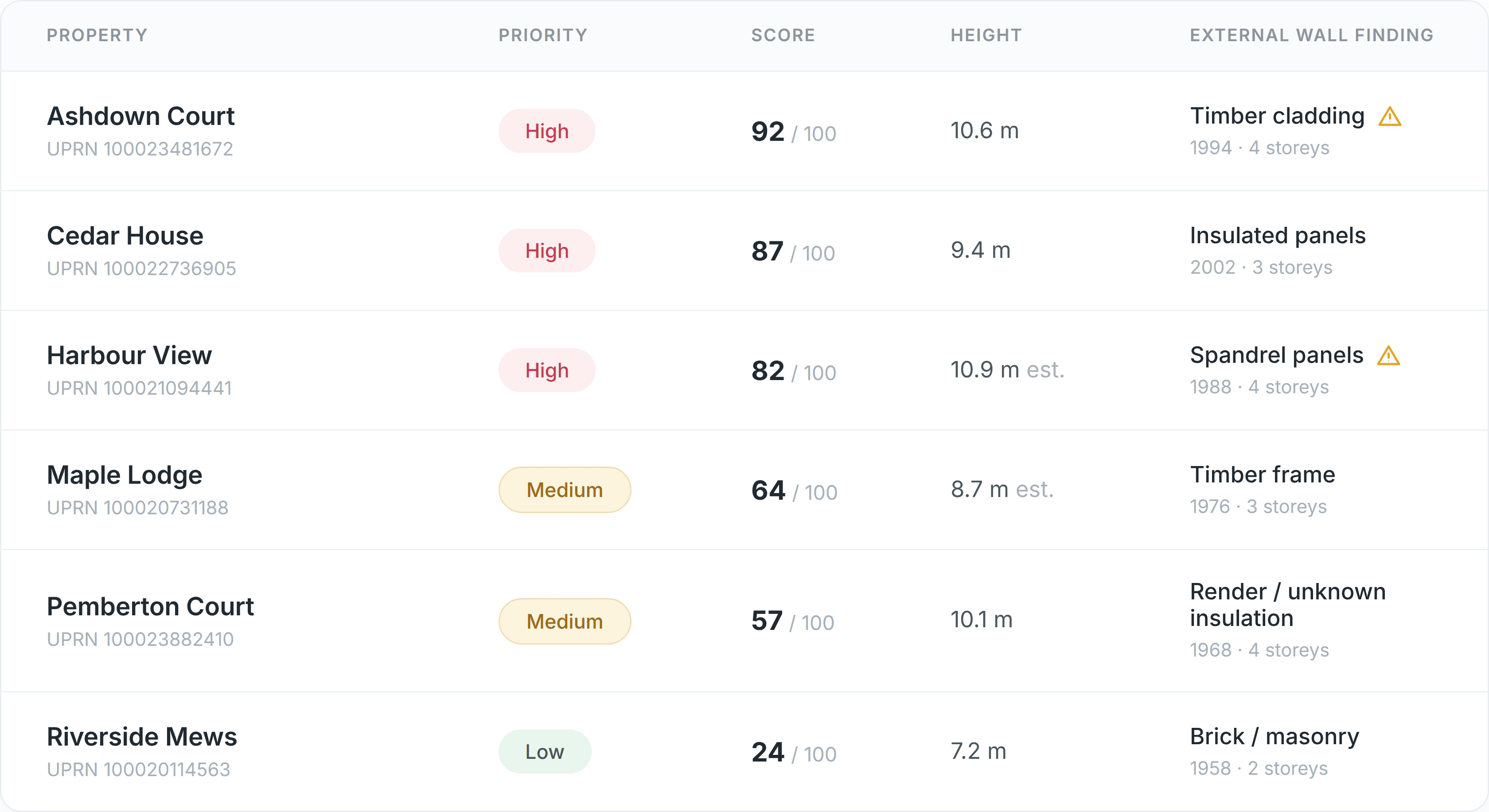
RiskBase itself doesn't produce a FRAEW, but the system includes a FRAEW template that a competent person can use to actually carry one out, directly against your existing building records. It helps you decide which blocks are worth pointing a FRAEW at, and gives you a route to get it done inside the same system your other records already sit in, so the finding becomes part of your building's history rather than a one-off PDF that goes back in a filing cabinet.
Identifying the right blocks early is what gives a FRAEW time to be booked, completed and submitted before the window closes.
This matters most for housing associations and local authorities holding large, mixed-age low-rise estates, and for the managing agents acting on behalf of RTM and RMC companies on leasehold blocks, since it's usually the agent doing the legwork even where the freeholder is the Responsible Entity of record.